- Email: advisory@orcwiz.com
- WhatsApp: +19136364497





For startups and SaaS companies handling customer data, security and trust are no longer optional. Enterprise clients increasingly require vendors to demonstrate strong security controls before signing contracts. One of the most recognized frameworks for proving this commitment is American Institute of Certified Public Accountants SOC 2 compliance.
Achieving SOC 2 compliance can feel overwhelming, especially for growing companies with limited resources. However, with the right preparation and a structured SOC 2 checklist, the process becomes far more manageable.
In this guide, we’ll walk through the essential SOC 2 compliance checklist for startups and SaaS companies, helping you understand what auditors look for and how to prepare effectively.
SOC 2 (System and Organization Controls 2) is a security and compliance framework developed by the American Institute of Certified Public Accountants. It evaluates how organizations manage customer data based on five Trust Services Criteria:
Most SaaS companies focus primarily on the Security criterion, while additional criteria are added depending on customer requirements and business operations.
SOC 2 reports are especially important for:
Many startups assume SOC 2 is only necessary for large enterprises. In reality, early-stage companies often lose deals because they cannot demonstrate adequate security controls.
SOC 2 compliance helps startups:
For SaaS companies targeting U.S. and international clients, SOC 2 compliance is increasingly becoming a standard expectation.
Below is a practical SOC 2 checklist designed specifically for startups and SaaS businesses preparing for their first audit.
Before implementing controls, determine:
A clearly defined scope prevents unnecessary complexity and keeps the audit manageable.
A security risk assessment identifies vulnerabilities, threats, and operational risks within your environment.
Your assessment should include:
Document all identified risks along with mitigation plans.
SOC 2 auditors expect formal documentation of your security program.
Essential policies typically include:
Policies should be regularly reviewed and approved by management.
Access management is a core requirement in every SOC 2 checklist.
Best practices include:
Limit administrative privileges to only authorized personnel.
Most SaaS companies operate in cloud environments such as Amazon Web Services, Microsoft, or Google.
Your SOC 2 checklist should include:
Misconfigured cloud infrastructure is one of the most common causes of security incidents.
Continuous monitoring helps detect suspicious activity and supports incident investigations.
Organizations should:
Auditors will often request evidence showing active monitoring practices.
Your organization should be prepared to respond quickly to security incidents.
An incident response plan should define:
Regular testing and tabletop exercises are highly recommended.
Human error remains a major cybersecurity risk.
SOC 2 readiness requires employee awareness training covering:
Training should be documented and repeated regularly.
Vendors and service providers can introduce security risks into your environment.
A strong vendor management process includes:
Keep records of all vendor evaluations and approvals.
Regular vulnerability scanning and remediation are essential components of SOC 2 compliance.
This includes:
Critical vulnerabilities should be addressed promptly and documented.
Startups often overlook disaster recovery until an outage occurs.
Your SOC 2 checklist should include:
Demonstrating operational resilience is important for both auditors and customers.
SOC 2 audits rely heavily on evidence collection.
Examples of audit evidence include:
Maintaining organized evidence throughout the year significantly reduces audit stress.
Before the formal audit, many startups conduct a SOC 2 readiness assessment or gap analysis.
This helps identify:
A readiness assessment can dramatically improve audit success rates.
Understanding the difference between SOC 2 Type I and Type II is important.
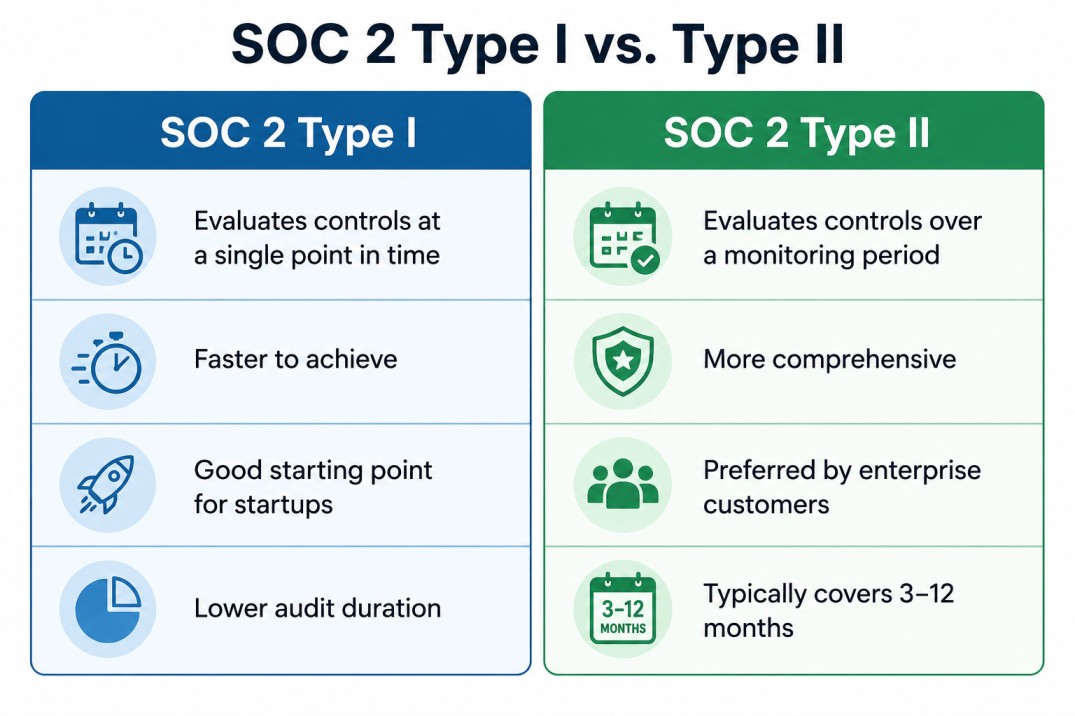
Most SaaS companies eventually pursue SOC 2 Type II certification to satisfy enterprise security requirements.
Many startups face similar obstacles during the SOC 2 journey:
Working with experienced compliance and cybersecurity advisors can simplify the process and reduce internal burden.
At ORCWIZ, we help startups and SaaS companies prepare for SOC 2 compliance with practical, business-friendly guidance.
Our services include:
We focus on helping growing companies build scalable security programs without unnecessary complexity.
SOC 2 compliance is more than a certification requirement — it is a strategic investment in trust, security, and business growth.
For startups and SaaS companies, following a structured SOC 2 checklist can streamline the compliance journey and help avoid costly delays during audits.
Whether you are preparing for your first SOC 2 assessment or improving an existing security program, starting early and building strong operational processes will position your organization for long-term success.