- Email: advisory@orcwiz.com
- WhatsApp: +8801743055464





In today’s digital economy, data security and trust are critical for SaaS companies. Clients expect software providers to protect sensitive data, maintain strong security controls, and demonstrate transparency in how they manage information.
One of the most widely recognized standards for this purpose is SOC 2.
For SaaS companies handling customer data, achieving SOC 2 compliance is often a key requirement to win enterprise clients, secure partnerships, and build long-term credibility.
In this guide, we will explain what SOC 2 certification is, why it matters, how the process works, and how SaaS companies can prepare for it.
SOC 2 stands for System and Organization Controls 2, a compliance framework developed by the American Institute of Certified Public Accountants.
SOC 2 focuses on how organizations manage and protect customer data based on five Trust Service Criteria: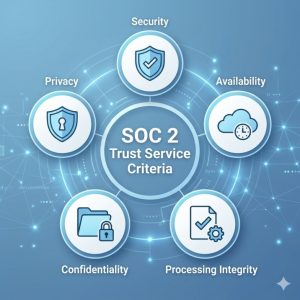
Unlike many other certifications, SOC 2 does not prescribe a fixed set of controls. Instead, it evaluates whether a company has implemented effective security policies, procedures, and operational controls to protect data.
For SaaS companies, this means proving that their platform and internal processes are designed to secure client information and prevent unauthorized access.
Enterprise clients often require vendors to demonstrate strong security practices. A SOC 2 report provides independent verification that your company follows industry-recognized security standards.
This significantly increases trust among potential clients and partners.
Many companies—especially in sectors like fintech, healthcare, and enterprise SaaS—require SOC 2 compliance before signing contracts.
Without SOC 2 certification, SaaS providers may struggle to pass vendor security assessments.
Preparing for SOC 2 encourages organizations to:
This improves overall cybersecurity posture and reduces risks.
In a crowded SaaS market, SOC 2 compliance demonstrates maturity and professionalism.
Companies with SOC 2 certification often stand out during procurement and vendor selection processes.
SOC 2 evaluations are based on five core principles.
Protecting systems against unauthorized access, cyberattacks, and data breaches.
Ensuring systems are operational and accessible when customers need them.
Guaranteeing that system processing is accurate, timely, and authorized.
Protecting sensitive business information from unauthorized disclosure.
Ensuring personal data is collected, used, and stored according to privacy standards.
Not all organizations need to include every criterion, but Security is mandatory for all SOC 2 reports.
SOC 2 reports are issued in two types.
Evaluates whether a company’s security controls are properly designed at a specific point in time.
It answers the question:
Are the right security controls in place?
Evaluates whether those controls operate effectively over time (usually 3–12 months).
It answers the question:
Are the controls working consistently?
Most enterprise clients prefer SOC 2 Type II, as it provides stronger assurance.
The SOC 2 journey typically includes the following steps.
Organizations evaluate their current security posture and identify gaps in policies, procedures, and controls.
Companies implement security controls such as:
Proper documentation is critical for SOC 2 audits. This includes:
A licensed auditor evaluates whether the organization’s controls meet SOC 2 requirements.
If the organization meets the requirements, the auditor issues a SOC 2 report confirming compliance.
The timeline depends on the company’s current security maturity.
Typical timeframe:
Companies that prepare early can complete the process much faster.
Many SaaS startups encounter challenges such as:
Working with experienced compliance consultants can help streamline the process.
Achieving SOC 2 compliance can be complex, especially for growing SaaS companies. This is where ORCWIZ provides expert support.
ORCWIZ helps organizations:
With expert guidance, businesses can achieve SOC 2 compliance faster and with less operational disruption.
For SaaS companies handling customer data, SOC 2 certification is no longer optional—it’s becoming a business requirement.
It helps organizations:
Companies that invest in SOC 2 compliance position themselves for long-term growth and global market opportunities.
Need help preparing for SOC 2 certification?
ORCWIZ provides expert consulting to guide SaaS companies through the entire compliance journey—from readiness assessment to audit preparation.
Book a free consultation today and start your SOC 2 compliance journey with confidence. 🚀